1. The AI Revolution and Its Blind Spots
The integration of AI tools like ChatGPT, Gemini, or DeepSeek into private and professional life has become commonplace. Large Language Models (LLMs) are complex computer programs trained to understand and generate human language. However, with these new capabilities come new challenges.
Challenge 1: The Pitfalls of AI Responses
Without precise and up-to-date information, LLMs tend to “hallucinate” – they invent facts or provide inaccurate answers that can easily go unnoticed. To improve accuracy, many chatbots allow users to upload additional documents, which are then analyzed alongside queries for more targeted answers. Some tools, like Google’s Gemini, can even analyze entire codebases to tailor generated code to a project.
Challenge 2: Data Privacy and Sovereignty
The more data shared with an AI, the better the results – but this exchange carries risks: Company or personal data may unintentionally be exposed to third parties like OpenAI, Google, or DeepSeek. Once externalized, control over data flow is lost. At best, this is an inconvenience; at worst, it can lead to breaches of confidential or personal data.
2. The Solution: Local or On-Premise LLMs
Protecting sensitive corporate data requires a clear strategy. Running Large Language Models (LLMs) on your own infrastructure (on-premise) offers a compelling solution.
The concept is simple: Instead of processing confidential information via external cloud services, the AI model runs entirely under your control. What once seemed like a utopian effort is now feasible thanks to increasingly efficient and compact LLMs. For initial experiments or occasional private use, small, optimized models that can even run on a standard PC are sufficient. (Learn how to set up a local LLM in under 5 minutes in our previous blog post.)
For professional enterprise applications, many models deliver impressive performance and can run on powerful standard hardware or dedicated in-house servers. This means an internal AI solution is within reach even without massive data centers, allowing scalability tailored to your needs. The advantages of an on-premise LLM for your business are significant:
- Unrestricted data sovereignty: Your data remains under your control and never leaves your network.
- Maximum security: The system integrates seamlessly with existing security measures (firewalls, encryption, etc.).
- Compliance assurance: Adherence to strict data protection regulations (e.g., GDPR) is easier to ensure since you oversee the entire data flow.
- Granular access controls: You define precisely which employees or departments can access specific information and functions.
However, even the best on-premise LLM reaches its limits when it comes to overseeing vast internal knowledge repositories. What can you do if your company has produced an impressive amount of documents and data over the years, and no one can quite keep track of everything anymore?
3. RAG in Detail: From Document to Vector
⚠️ This section gets slightly technical, but don’t worry – we’ll guide you through it.
A basic RAG system consists of two core components: a vector database (VectorDB) and an embedding model.
- The VectorDB is a specialized database optimized for storing and efficiently searching numerical vectors.
- The embedding model converts files (text, images, etc.) or queries into such vectors.
What Is a Vector in This Context?
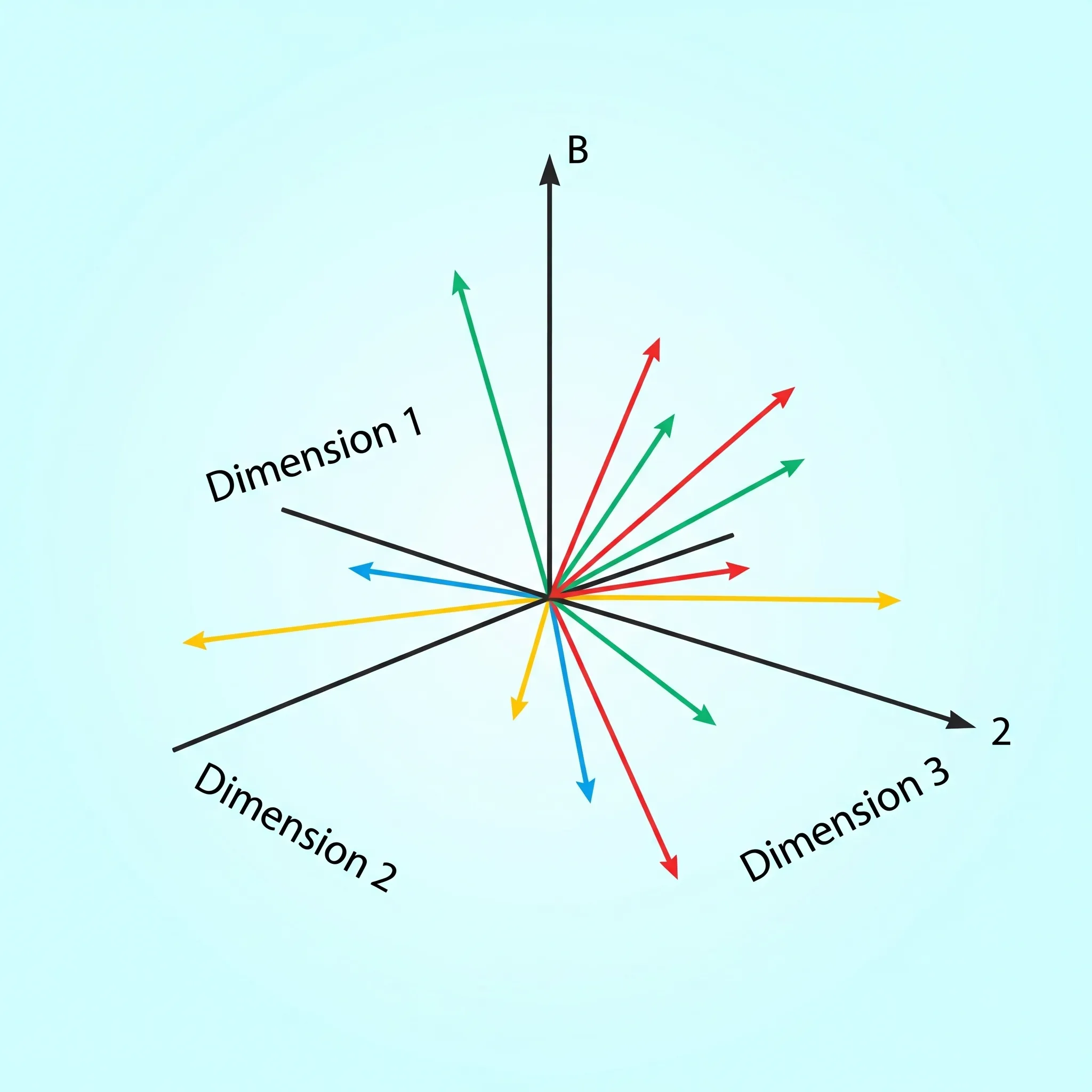
Basically, a vector is a long list of numerical values, where each value represents the similarity of a given object (such as text, image, etc.) to a particular feature. By describing how closely an object matches each of these features, algorithms can find similar results through spatial search. The more similar two objects are, the smaller the distance between them in the vector space.
What Is an Embedding Model?
The embedding model generates a high-dimensional vector (a very long list) from input data. The choice of model depends on the data type and required languages. For example, a pure text embedding model cannot relate diagrams or images. A model trained only on English texts cannot correctly compare the content of German documents. For these use cases, there are already multimodal (different input types such as text, image, audio) and multilingual (different languages) models, as well as a mix of both.
With the right embedding model, all internal documents are processed into vectors and stored in the optimized database. Additional metadata (e.g., access permissions) can be assigned during this step. Updating the database with new documents is straightforward.
4. The LLM: The Core of Answer Generation
The Large Language Model (LLM) delivers the final, articulated response. A question enriched by RAG with relevant context can be routed to any LLM, provided it supports the input language, modality, and data volume.
Cloud LLMs: Convenient but with Caveats
Major providers (OpenAI, Google, DeepSeek) offer APIs for programmatic queries, acting as intermediaries between users and AI. RAG-preprocessed questions can be forwarded to these APIs for answers. These services are reliable and have varying strengths. Billing is typically based on tokens (representing words, word fragments, or punctuation), so input/output volume directly impacts costs: More context improves answers but increases expenses.
A key drawback remains: Internal data may be shared with third parties, compromising control.
On-Premise LLM: Full Control
Your company retains the strongest control when data never leaves your own servers. Although the hardware requirements for LLMs have increased in recent years, more models are also being developed that achieve good results with fewer resources. Thanks to Retrieval-Augmented Generation (RAG), there is also no need for expensive and computationally intensive training or fine-tuning of the LLM on your specific data. This makes the possibility of having your own internal AI increasingly feasible.
5. How to Use This System
For users, the process is seamless: Ask a question, receive a tailored answer.
In the background, the system receives the request, identifies the user, and also converts their question into a vector. This vector is searched in the vector database, and a list of the most relevant documents is identified. These documents are then retrieved and added to the user’s original question before being passed on to the actual LLM.
The advantage? Users don’t need to know which documents are relevant – the system handles research and provides the LLM with precise context.
6. Further Considerations: The Future of Your AI Solution
The intelligent separation of data preprocessing (RAG) and actual AI generation (LLM) allows for flexible expansion of the system’s functions. For example, it is possible to recognize the intent of a question and change the workflow based on that. This means you don’t necessarily need the most powerful and expensive model for simple chats or email responses; instead, you can use smaller, more efficient models for specific tasks, while the RAG system provides the context for accuracy.
TL;DR Summary
RAG turns LLMs into a secure and precise tool for your internal knowledge. By operating on-premise, you retain full control over your data, reducing hallucinations and enriching responses with your own documents. This brings your company knowledge to life and makes it usable, all without compromising on security and compliance.